

The Beating Heart of Catholic Education; How Faith, Hope, and Love Shape Every Catholic School.

Across the Lower Mainland, Catholic schools form the living heart of the Church’s mission in education. From the laughter of kindergarteners learning to pray before lunch to graduates discerning how to live their faith in a restless world, Catholic Independent Schools share one pulse: a commitment to form hearts and minds in Christ.
Each school is distinct, yet all are bound by the same conviction that faith, hope, and love are not ideals but daily practices. They are lived in classrooms, chapels, and community outreach. They guide teachers who see their work as a vocation. They shape parents who serve as the first educators of their children. They animate students who are taught to think critically, act with compassion, and see the face of God in others.
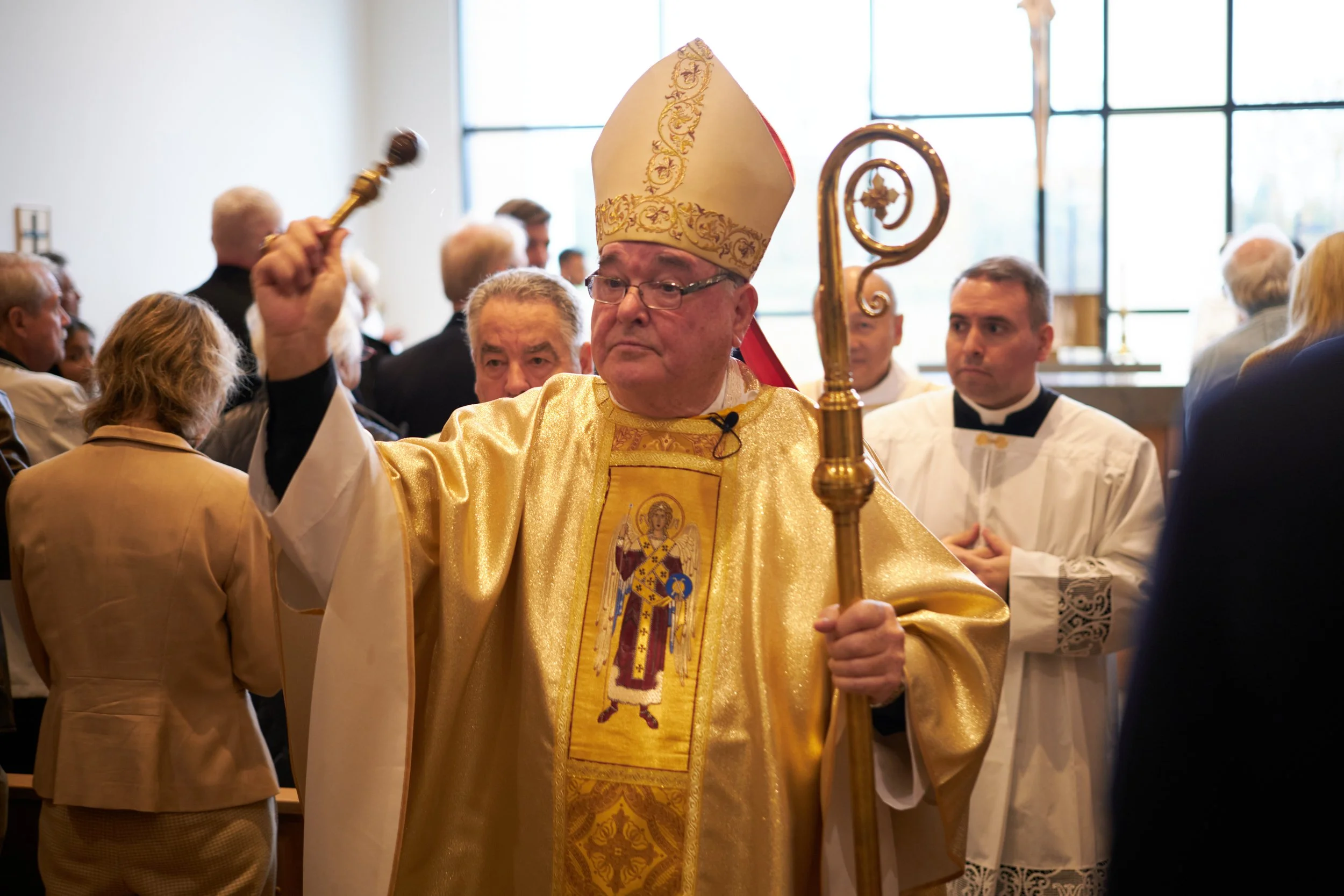
Photo provided by The BC Catholic
At the dedication of Saint John Paul II Academy in Surrey, a CISVA Affiliate school, Archbishop Richard Gagnon offered words that reach far beyond a single campus. He began with an image that captured the essence of Catholic education:
“There is one tiny valley that beats unseen and unheard within the rest, and if that beating were to cease, all external activity would cease with it. Something of the same importance belongs to those homes of silence and recollection where men and women serve God in faith. There lies the heart of the Church.”
That image became the foundation of his homily and a reflection of what defines every Catholic school in British Columbia. “What is the heart of the matter in this celebration?” he asked. “Better still, what has led to the establishment of this place of learning? Basically, it is faith, the fruit of faith in Jesus Christ.”
He recalled philosopher Edmund Husserl, who stood before the Cologne Cathedral and said simply, “The people who did this had faith.” Archbishop Gagnon explained that the same truth applies to Catholic education. “This school, brothers and sisters in Christ, is likewise the fruit of faith. It is also the fruit of hope. Trust in the promises given to us by our Lord Jesus Christ about eternal life and how we are to reach it. It is a hope that our youth will be formed into men and women for others, to serve God and neighbour. And it is a fruit of charity, of love. Love is our response to knowing that we have first been loved.”
He reminded those gathered of Pope Benedict XVI’s words that “education is one of the highest forms of Christian charity” and traced a line from the first classrooms founded by the Sisters of St. Ann in 1858 to the modern schools of today. “The same beating heart that animated that first school beats at the centre of this new place of learning and Christian formation.”
That heart, he said, rests on three theological virtues: faith, hope, and love. “They are called theological because they are God-given. And where would we be without them?”
Archbishop Gagnon connected Scripture to this mission through the story of Ezra reading the Law before the people after exile. “The people receive it with openness and love, and their faith is strengthened for a new spiritual renewal that leads to the rebuilding of the Temple.” He then turned to the history of Catholic education in British Columbia. “It takes great faith, firm hope, and a heart of love to establish and sustain a Catholic school,” he said. “Many religious orders were founded specifically for this mission. In British Columbia, two of the best known are the Sisters of St. Ann and the Sisters of the Child Jesus, tremendous women dedicated to their calling. They founded our province’s Catholic school system and have now entrusted that legacy to us.”
He described the goal of Catholic education as the full formation of the human person: academic excellence, physical growth, social fraternity, and faith-based spirituality. He cited Pope Francis’s pastoral letter Drawing New Maps of Hope, which names St. John Henry Newman as co-patron of Catholic education alongside St. Thomas Aquinas, showing how intellect and spirituality must remain united.
“Spirituality is not an optional addition. It lies at the core of who we are,” Archbishop Gagnon said. “The Church does not merely have a mission. Rather, Christ’s mission has a Church. Each member, as a temple of the Holy Spirit, shares in that mission, and education is a vital part of it.”
He spoke of Zacchaeus climbing the sycamore tree to see Jesus. “Something was already stirring in his heart, a heart once greedy and alienated by sin. Jesus looked up and said, ‘Zacchaeus, hurry down, for I must stay at your house today.’ Surprised and transformed, Zacchaeus made amends for all he had done wrong. Jesus then declared, ‘Today salvation has come to this house.’”
“If Christ’s mission has a Church, then it also has a person, you and me,” he said. “Our faith is not a one-day-a-week religion but a way of life. Jesus is the Way, the Truth, and the Life.”
He concluded with gratitude for all who sustain Catholic education: clergy, benefactors, teachers, staff, and especially parents, the first teachers of their children. A Catholic school, he said, “is a concrete expression of the Gospel. It becomes an educational gesture, a relationship, a culture.”
Before blessing the academy’s new chapel, Archbishop Gagnon explained its meaning as a visible symbol of the invisible heartbeat. “It will be a physical reminder of the beating heart of faith, hope, and love at the centre of everything. We will anoint this beautiful chapel with the oil of chrism. We will anoint the altar as well, for it represents Christ himself, the High Priest, the Victim, and the Altar of his own sacrifice for our sins.”
His final words continue to echo through every CISVA school:
“All these sacred actions, including the blessing of this academy, go straight to the heart of the matter, the beating heart of faith, hope, and love. And that is the whole point. May God be with you.”
That heart still beats quietly, faithfully, and with purpose across every Catholic school in the Archdiocese of Vancouver. It beats in the joy of students, the dedication of teachers, and the prayer of families who continue the mission begun more than a century and a half ago. It is the same heart of faith that built the first wooden schoolhouse in Victoria, the same hope that forms new generations of learners, and the same love that transforms every act of teaching into a work of grace.